
Atwater Previous Residents by Era
A useful Atwater previous residents search starts by naming the period each source can actually cover. The table separates online deed indexing from archive work, occupancy snapshots from ownership evidence, and present permit depth from an honest research gap.
| Source | Years It Covers | Where Held | What It Shows |
|---|---|---|---|
| Atwater RecorderWorks | 1963 to present online; earlier at the office | Merced County Recorder | Atwater transfers, liens, document numbers, indexed parties |
| Local Atwater city directories | 1914, 1917, 1920, 1922, 1926-1931, 1935; later museum years | Courthouse Museum, NARA, library | Named subscriber or householder, address, spouse or occupation clues |
| Federal census | 1900 through 1950 public releases | NARA, FamilySearch, library databases | Atwater household members, ages, relationships, residence, and tenure fields |
| Atwater building permits | Current system depth not officially stated | Atwater Building or CPRA request | Construction, applicant, contractor, inspections, and work dates |
| Atwater parcel maps | Current and archived maps by book and page | Assessor, Recorder, museum | Lot, block, APN continuity, and map geometry, not title |
| Atwater Sanborn maps | Exact Atwater sheet years not located | Library of Congress or State Library | Building footprints, use, and older address layout when a sheet exists |
The Atwater directory run is intermittent, not annual. An Atwater gap is a prompt to try the museum, the Merced library, newspapers, or a dated deed rather than a reason to fill in a person by guesswork.
Starting an Atwater Previous Residents Trail
Begin with the Atwater address as it appears today, but do not let its postal spelling become the whole identity of the property. USPS can normalize delivery details. Atwater city maps and Merced GIS can then show whether the site is inside Atwater, within the sphere of influence, or in surrounding county territory.
- Write down the complete Atwater situs address, postal city, ZIP, and the date of the source that supplied it.
- Resolve the Atwater address to an APN through the county tax or GIS route, keeping mailing and situs addresses separate.
- Use the APN, subdivision, lot, block, or legal description to identify the current Atwater parcel record.
- Find the Atwater acquisition deed, note its grantor, grantee, recording date, document number, and legal description.
- Search the prior grantee as an earlier buyer, then move the Atwater chain back one recorded transfer at a time.
The Atwater chain is an address-to-land-to-party process. A deed can establish a transfer of an interest, while a directory or census can place a household at an Atwater address for a particular publication or enumeration date.
Atwater Deed Chains and the 1963 Cutoff
RecorderWorks provides a free Atwater grantor and grantee index from January 1, 1963 through the current partial recording date shown by the portal. Its Atwater name search accepts a last name, with a partial first name recommended. The search can allow partial matches, use a recording-date pair, or switch to a document number mode. A document number can be opened, then an indexed party can be selected to list connected Atwater documents by type and date.
| RecorderWorks field | Use in an Atwater chain |
|---|---|
| Name role | Choose the portal’s grantor, grantee, or other indexed role where offered. |
| Person or business name | Enter LAST FIRST; a last name is the minimum and a partial first name can reduce a broad result. |
| Allow Partial Match | Broaden spelling or name matching, then check the parcel and dates before treating a hit as the same person. |
| From and Through dates | Limit the recording date range; the online land index begins in 1963. |
| Document number | Open a known instrument and follow its indexed party links. |
| Cart and order | Prepare a copy order; an index hit is not the same as a free Internet image. |
For a pre-1963 Atwater deed, carry the legal description, map book and page, party name, recording year, and any known document reference to the Merced Recorder counter. The online cutoff is a boundary between access methods, not the end of the Merced County record for Atwater.
The Merced recorded-document ordering page states that an Atwater copy costs $3 for the first page of each document and $1 for each additional page; certification adds $2 per document. Mail orders use a cashier’s check or money order, while card orders can be emailed with authorization and carry a $2.50 surcharge.
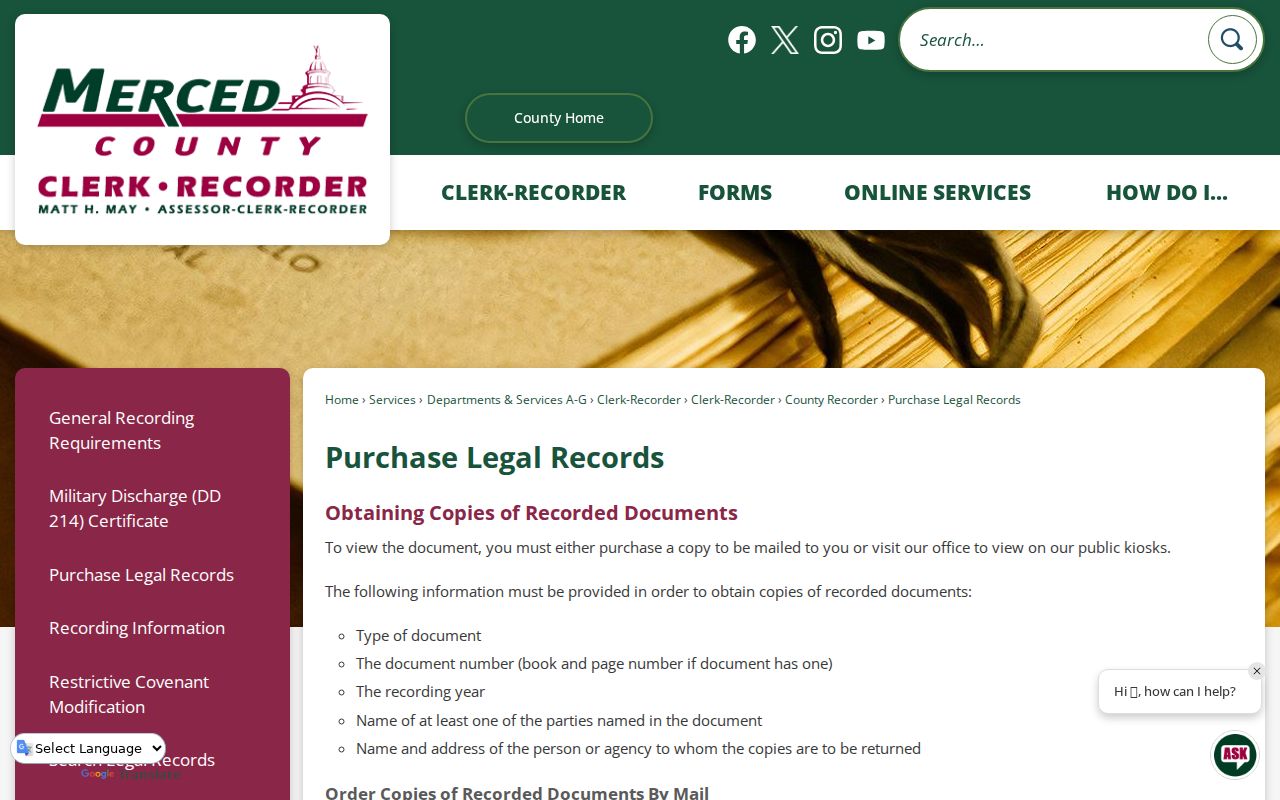
The recorded-document capture is a reminder to budget for the deed image or certified copy that connects an indexed name to the Atwater legal description and parcel chain.
Legal Descriptions for Atwater Previous Residents
An Atwater street address can change form, while a legal description follows the land. An APN is useful for Atwater parcel bookkeeping. A lot and block, subdivision reference, or metes-and-bounds description is the stronger bridge when an old deed, rural route, or directory uses a different Atwater address. The assessor parcel-map downloader uses the first five APN digits as a map book and page prefix.
Do not treat an Atwater assessment map as title. Merced County describes the parcel map service as an assessment tool, and the Assessment Inquiry portal documents parcel status, tax-rate-area code, values, exemptions, characteristics, and assessment maps. It does not provide a public online owner-name or address search. The Atwater deed and its legal description must carry the ownership step.
The 2007 Postal Bulletin change from some Merced 95340 deliveries to Atwater 95301 is important when old Atwater address strings are compared with new ones. Retain the old ZIP and date, then use APN and legal description to test whether the Atwater land stayed the same.
Atwater Directories as Occupancy Snapshots
Atwater-inclusive city directories provide the household layer that Atwater deeds cannot. The Courthouse Museum verifies Merced County Business Directory volumes for 1877 and 1884-85; Polk Merced City Directory volumes for 1914, 1928-29, 1930-31, 1935, 1938, 1941, 1963, and 1966; and Polk Merced-Atwater volumes for 1971, 1972, 1980, 1988, and 1989. It also says other Polk Merced and Merced-Atwater years are at the Merced County Public Library.
NARA’s inventory independently lists Merced-Madera directories including Atwater for 1914, 1917, 1920, 1922, 1926-1931, and 1935. The California State Library’s Merced research guide tells researchers to search both Merced and individual city names in its Atwater city-directory and telephone-book databases. Telephone books can fill a missing Atwater year, but a subscriber entry does not represent every adult at an address.
An Atwater named entry was not inspected in an open authoritative digitized volume. At the museum or library, record the printed name, spouse or widow notation, occupation, address, telephone, rural route or box, any occupancy mark, street-section cross-reference, and the volume’s abbreviation key. Publication date is evidence of a listed Atwater household at that point, not proof of a full-year stay.
The historical collection itself is described in more depth on the Atwater city directory page, while the backward trail here uses only the years and fields needed to test one address.
Pairing Atwater Previous Residents With Census Records
The Atwater census trail supplies a dated household snapshot. Federal census releases are public through 1950 under the 72-year rule. An Atwater directory adds local address and occupation clues between census years, while the census can show household members, ages, relationships, residence, and tenure fields that a deed index cannot.
- Start with an Atwater directory year and copy the exact surname, given initials, spouse, address, and stated occupation.
- Check the 1920 census against the 1917 and 1922 Atwater directory years, allowing for a move or a changed street label.
- Pair the 1928-31 and 1935 Atwater volumes with the 1930 census, then repeat the same comparison with later available volumes.
- Compare the Atwater household’s land interest with the deed chain instead of calling every directory name an owner.
- When a listing disappears, check newspapers, obituary notices, probate, and the next address before concluding that the person left Atwater.
Two independent Atwater anchors are safer than a surname alone. An address plus spouse, an APN plus legal description, or a dated occupation plus a census household can separate Atwater namesakes without turning a thin clue into a claim.
Permits and Maps Around an Atwater Address
Atwater permits can date a building or alteration, but an applicant, contractor, or responsible party is not automatically a resident. City projects belong with Atwater Community Development or an Atwater public-records request after the city boundary is checked. Unincorporated county work uses Merced Accela. The portal’s street-number range and percent wildcard can find Atwater address records, but the research does not state a complete historical depth for permits.
Atwater parcel maps show lot and block continuity. The Courthouse Museum also holds more than 600 maps, including 1909, 1919, and 1932 county owner maps, plats, subdivisions, roads, and Sanborn-related material. The Library of Congress Sanborn collection is a useful catalog route, but exact Atwater sheet years were not located in the authoritative run used here. A map can show a footprint or farm parcel while an Atwater deed supplies the legal transfer.
For a current Atwater address chain, the Atwater street directory explains how to route an address to APN, permit, and deed sources. That Atwater workflow complements the historical sources without treating a permit name as proof of occupancy.
Probate, Obituaries, and Atwater Family Connections
When a past Atwater occupant dies or a household disappears, probate and obituary records can close the gap. Merced’s online court portal excludes probate, adoption, criminal, family, juvenile, paternity, mental-health, and traffic material. Lawful, nonconfidential probate inspection and copies therefore move to the clerk. The court’s record-search form asks for a searched name, aliases, maiden name, date of birth, case number, approximate dates, copy type, and certification details. A clerk search over ten minutes is listed at $15, with additional copy and certification charges.
Atwater obituaries are secondary evidence. They can supply kin names, a prior place, an occupation, or a funeral home, but an Atwater deed, census, vital record, or probate filing should corroborate the date and relationship. Merced Museum, the library’s newspaper databases, and regional newspaper holdings are practical routes for notices that are not indexed on the open web.
For an Atwater adoption or birth-family question, use the California Department of Social Services adoptee information route. It provides consent and contact procedures, including AD 902 and sibling forms AD 904A and AD 904B, along with a nonidentifying-information process. Adoption records remain sealed, so a public-record trail should never replace the official family-contact channel.
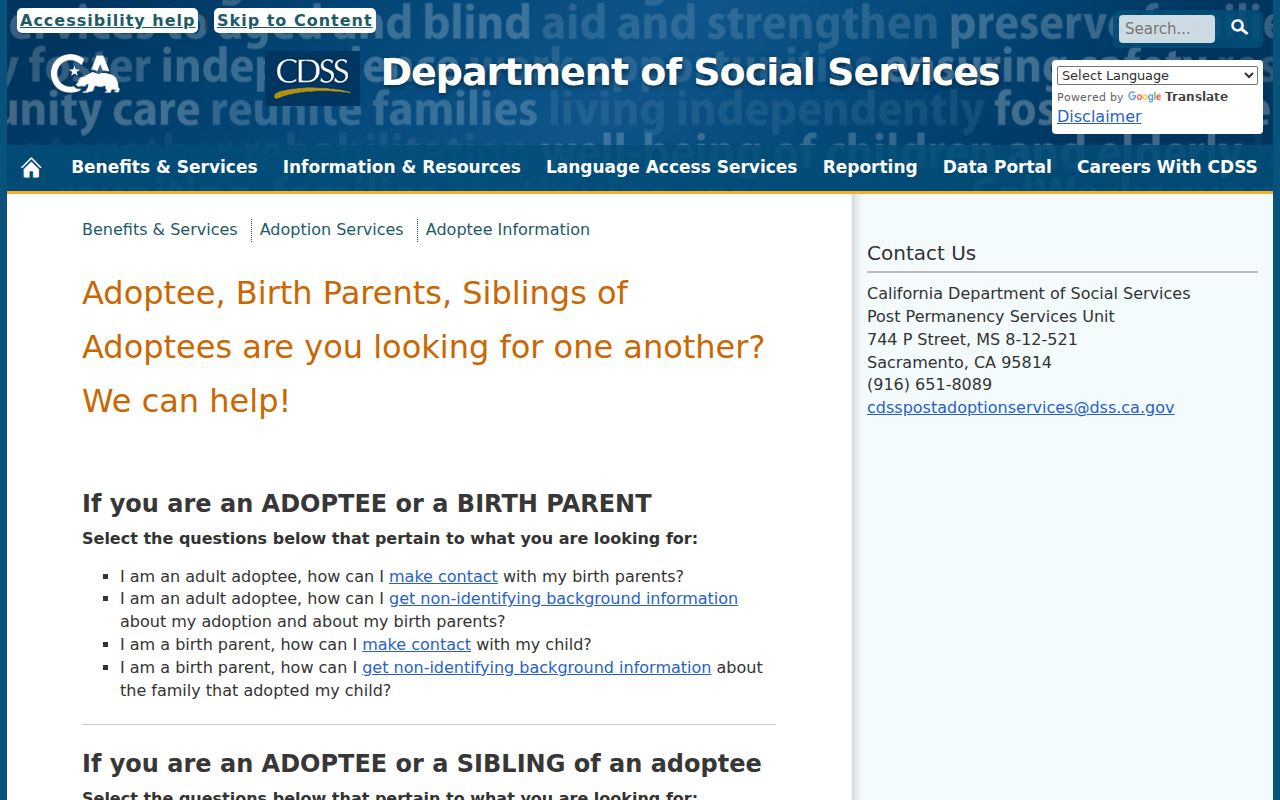
The CDSS capture points to a controlled Atwater family-contact route rather than a public list of birth parents, adoptees, or siblings. That distinction protects the people a family-history search is meant to reconnect.
Honest Limits on an Atwater House History
Several gaps are part of the verified Atwater record map. The exact Atwater Sanborn sheet years were not located. The museum does not publish every additional Polk or reverse-directory year. No authoritative chronology of Atwater street renumbering was found, and no evidence supports a story that a courthouse fire destroyed Merced’s core deed run. Atwater’s 1912 and 1920 fires explain possible rebuilt structures, not a proven loss of county record books.
Atwater’s settlement became a town in 1888 and incorporated on August 16, 1922. Pre-incorporation work should therefore be searched under county land, rural routes, regional directories, newspapers, census records, and legal descriptions rather than assumed to be in Atwater city minutes. The 2007 ZIP change is another reason to preserve Atwater source dates and original address text.
Lawful personal research. Atwater previous residents records can support family history, estate work, property-history questions, and scam checks; public availability never permits stalking, unwanted contact, intimidation, or harassment.